
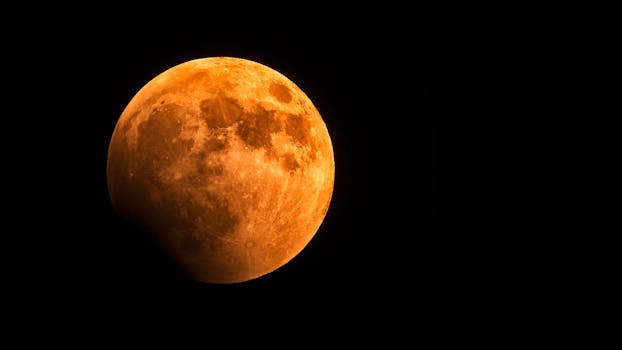
Residents of Newfoundland and Labrador are in for a celestial treat on the night of March 13, 2025, as a total lunar eclipse—often referred to as a “Blood Moon”—is set to occur. This rare event happens when the Earth comes directly between the Sun and the Moon, casting Earth’s shadow over the lunar surface and giving it a reddish hue.
What is a Total Lunar Eclipse?
A total lunar eclipse transpires when the Sun, Earth, and Moon align perfectly, with Earth positioned in the middle. This alignment causes Earth’s shadow to fall upon the Moon, leading to a gradual darkening and a subsequent transformation into a deep red or orange color. The reddish tint, often called a “Blood Moon,” results from Earth’s atmosphere filtering out shorter blue wavelengths of light, allowing the longer red wavelengths to illuminate the Moon’s surface.
Viewing Schedule in Newfoundland and Labrador
The total lunar eclipse will be fully visible across Newfoundland and Labrador, weather permitting. Here are the key phases of the eclipse, adjusted for Newfoundland Standard Time (NST):
-
- Penumbral Eclipse Begins: 12:27 a.m. NST on March 14
-
- Partial Eclipse Begins: 1:39 a.m. NST
-
- Totality Begins: 2:56 a.m. NST
-
- Maximum Eclipse: 3:28 a.m. NST
-
- Totality Ends: 4:02 a.m. NST
-
- Partial Eclipse Ends: 5:18 a.m. NST
-
- Penumbral Eclipse Ends: 6:30 a.m. NST
The totality phase, during which the Moon will exhibit its characteristic reddish glow, will last approximately 66 minutes, from 2:56 a.m. to 4:02 a.m. NST.
Viewing Tips
Observing a lunar eclipse is safe and requires no special equipment; the phenomenon can be enjoyed with the naked eye. However, using binoculars or a telescope can enhance the experience by providing a closer view of the Moon’s surface as it transitions through the eclipse phases. For optimal viewing, find a location with an unobstructed view of the sky and minimal light pollution. Given the late-night timing and March’s typically chilly temperatures, dressing warmly and bringing along blankets or hot beverages is advisable.
Weather Considerations
As with any astronomical event, clear skies are essential for optimal viewing. Residents are encouraged to monitor local weather forecasts leading up to the event to ensure visibility conditions are favorable.
Astrological Significance
This particular full Moon is traditionally known as the “Worm Moon,” marking the time of year when earthworms start to appear as the ground thaws, signaling the approach of spring. The combination of the Worm Moon with a total lunar eclipse adds a unique dimension to this month’s lunar display.
Looking Ahead
For those who may miss this event, the next total lunar eclipse visible from North America is anticipated in March of the following year.
Don’t miss this opportunity to witness a spectacular natural event that beautifully showcases the dynamics of our solar system.
For Detailed information visit: https://www.timeanddate.com/eclipse/globe/2025-march-14