
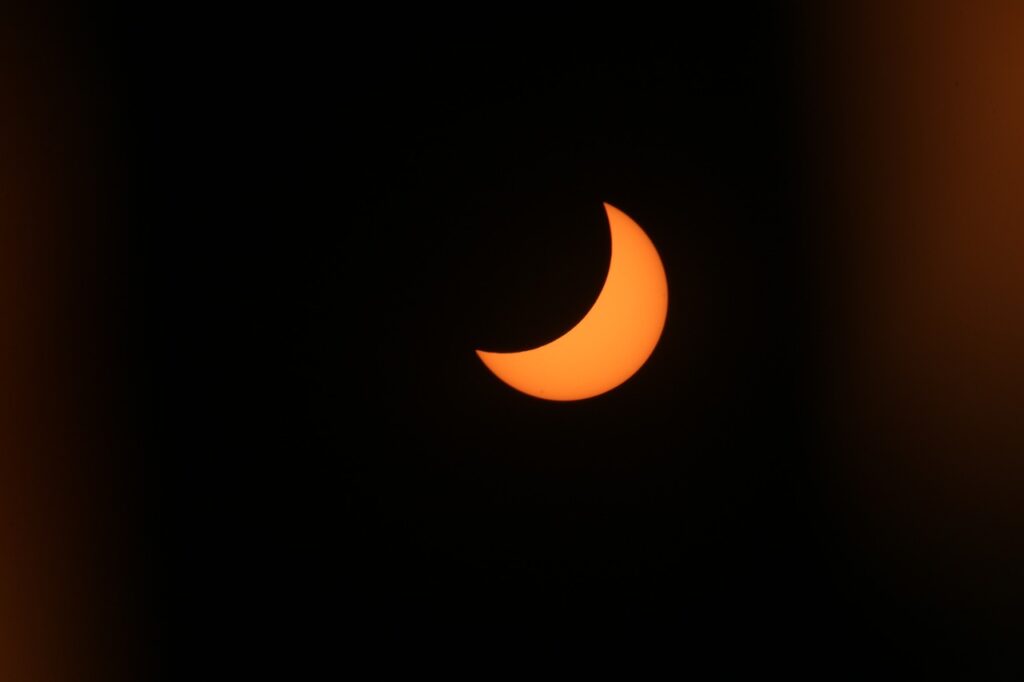
Fresh off witnessing a stunning lunar eclipse earlier this month, sky watchers in Newfoundland and Labrador are in for another celestial treat—a partial solar eclipse on March 29, 2025. This rare occurrence of back-to-back eclipses offers an exciting opportunity to observe two different types of astronomical events within a short time span.
Eclipse Timing and Coverage
The partial solar eclipse will commence at approximately 6:57 a.m. NDT, reaching its maximum obscuration around 7:52 a.m., and concluding by 8:51 a.m. During this period, the extent of the Sun covered by the Moon will vary across different locations:
- St. John’s: Approximately 82% of the Sun’s disk will be obscured.
- Corner Brook: Around 86% coverage.
- Gander: Approximately 84% coverage.
- Happy Valley-Goose Bay: Up to 89% coverage.
- Labrador City: Approximately 90% coverage.
These variations are due to the geographical positioning within the province, with western and northern regions experiencing a slightly higher degree of obscuration.
Viewing Safety
Observing a solar eclipse requires proper eye protection to prevent serious eye injury. Standard sunglasses are insufficient; instead, viewers should use certified eclipse glasses or solar viewers that meet international safety standards. Alternatively, indirect viewing methods, such as pinhole projectors, can be employed to safely observe the eclipse without looking directly at the Sun.
Weather Considerations
Late March in Newfoundland and Labrador often presents variable weather conditions, including cloud cover that could impede visibility of the eclipse. Prospective observers are advised to monitor local weather forecasts leading up to the event and consider selecting viewing locations with historically favorable weather patterns to enhance the likelihood of a clear view.
Cultural and Educational Significance
Solar eclipses have long captivated human interest, offering both cultural significance and educational opportunities. Local schools, astronomy clubs, and science centers may organize events or viewing parties to educate the public about the science behind eclipses and safe viewing practices. Engaging in these community events can enrich the experience and provide a deeper understanding of this astronomical phenomenon.
Conclusion
The partial solar eclipse on March 29, 2025, presents a remarkable opportunity for the residents of Newfoundland and Labrador to witness a rare celestial event. By prioritizing safety and staying informed about weather conditions, observers can fully appreciate the spectacle of the Moon’s passage across the Sun, deepening their connection to the wonders of the cosmos.