
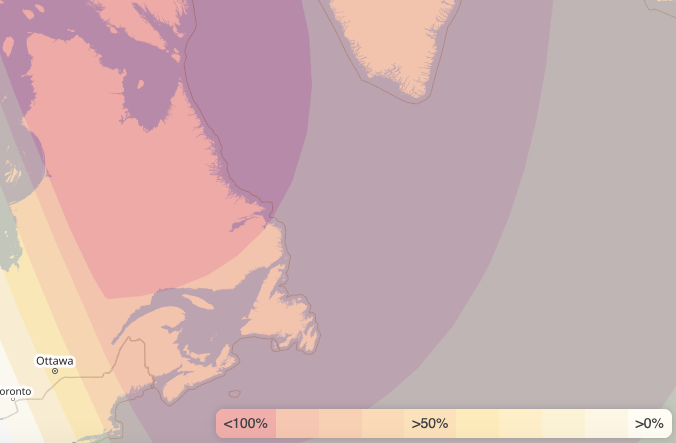
This Saturday morning, March 29, 2025, a partial solar eclipse will be visible across Newfoundland and Labrador. This celestial event occurs when the Moon partially covers the Sun, creating a dramatic crescent shape in the sky. With 85–86% of the Sun obscured at peak coverage, this will be one of the most significant eclipses visible in our region for years.
What Makes This Eclipse Unique?
-
High Coverage: Around 85–86% of the Sun will be covered at maximum eclipse, making this a particularly striking event.
-
Early Morning Eclipse: The event happens just after sunrise, meaning the Sun will be low on the horizon—a great opportunity for photographers and skywatchers.
-
Gradual Changes in Light: Although it won’t get completely dark, there will be a noticeable dimming of daylight as the eclipse reaches its peak.
-
Longer Event: The partial eclipse will last almost two hours, giving plenty of time for safe viewing.
Eclipse Timing Across Newfoundland and Labrador
The exact timing of the eclipse varies slightly across the province, but here’s a breakdown for key locations:
St. John’s
-
Eclipse begins: 6:57 a.m.
-
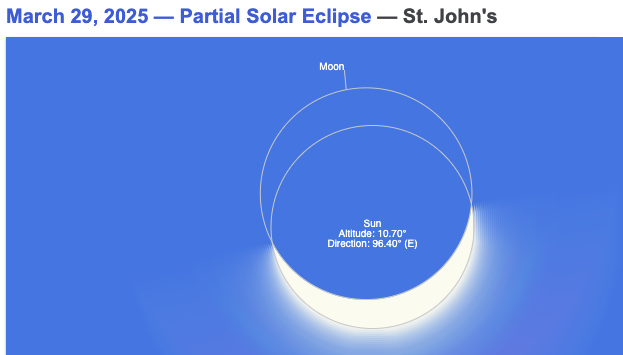
Maximum eclipse (85% coverage): 7:53 a.m.
-
Eclipse ends: 8:51 a.m.
Corner Brook
-
Eclipse begins: 7:00 a.m.
-
Maximum eclipse (86% coverage): 7:54 a.m.
-
Eclipse ends: 8:52 a.m.
Gander
-
Eclipse begins: 7:00 a.m.
-
Maximum eclipse (85% coverage): 7:55 a.m.
-
Eclipse ends: 8:53 a.m.
Labrador City
-
Eclipse begins: 6:53 a.m.
-
Maximum eclipse (83% coverage): 7:45 a.m.
-
Eclipse ends: 8:39 a.m.
The peak eclipse will occur roughly an hour after sunrise, meaning the Sun will still be relatively low on the horizon, making it easier to observe (with proper eye protection).
For detailed eclipse timings in your specific location, visit timeanddate.com.
What Will Happen During the Eclipse?
-
6:57 a.m. (Start of Eclipse in St. John’s): The Moon will begin to cover the Sun, appearing as if a small “bite” has been taken out of it.
-
7:53 a.m. (Maximum Eclipse in St. John’s): About 85–86% of the Sun will be obscured, creating a crescent-like shape. The sky may take on an eerie dimness.
-
8:51 a.m. (End of Eclipse in St. John’s): The Moon will completely move away from the Sun, returning daylight to normal.
Since this is a morning eclipse, visibility will depend on cloud cover and atmospheric conditions. Clear skies will provide the best views!
Where to Watch the Eclipse?
To get the best view of the eclipse, find a location with an unobstructed view of the eastern horizon. Some great places to watch include:
-
Signal Hill (St. John’s): A high vantage point with a clear view of the sunrise.
-
Cape Spear: The easternmost point in North America—perfect for early morning skywatching.
-
Gros Morne National Park: Ideal for those on the west coast who want a clear view of the sky.
-
Labrador Coastal Areas: Open areas with minimal light pollution will enhance the experience.
How to View the Eclipse Safely
- Never look directly at the Sun! Even when partially covered, it can cause permanent eye damage.
- Use Eclipse Glasses: Wear ISO 12312-2 certified glasses. Regular sunglasses are NOT safe.
- Use a Pinhole Projector: Project the Sun’s image onto a surface for indirect viewing.
- Use a Solar Filter for Cameras: If photographing the eclipse, use a solar filter to protect your camera lens.
- Check the Weather: Cloudy skies could block the view, so check forecasts before heading out.
For more information on safe viewing methods and eclipse science, check timeanddate.com.
This will be a spectacular event for skywatchers in Newfoundland and Labrador. With 85–86% of the Sun covered, this will be one of the most dramatic solar eclipses visible in our region for years.
- Photographers: Get ready for a stunning crescent-shaped sunrise eclipse!
- Early Risers: Pick a high vantage point for the best view.
- Everyone Else: Just make sure to protect your eyes while watching!
Make sure to wake up early, find a clear viewing spot, and enjoy the show!